The biblical meaning of William is a popular topic among parents and Christians seeking a name with spiritual value. While William is not mentioned in the Bible, it reflects biblical qualities like strength, protection, courage, and faithful leadership.
In this guide, you’ll discover the biblical meaning of William, its origin, Hebrew and Greek connections, spiritual symbolism, Urdu meaning, and the faith-based lessons that make this classic name meaningful in 2026.
What Is the Meaning of William?
The short answer: William means “resolute protector” or “strong-willed guardian.” It’s a compound name, built from two older words fused together over a thousand years ago. That combination gives the meaning of William its distinct flavor of strength paired with care, someone determined enough to stand their ground and protective enough to use that strength for others.
Meaning of William Name

William has stayed near the top of naming charts for centuries, and that staying power says something. It entered England after 1066 and quickly became the country’s most common male name for generations, and it still carries a sense of tradition and quiet authority today.
Common short forms and variants include:
- Will, Willy, Wil
- Bill, Billy
- Liam (the Irish form, now hugely popular on its own)
- Wilhelm, Willem, Guillaume, Guillermo, Guglielmo
Each variant traces back to the same root meaning. Whether someone goes by Liam or Bill, the meaning of William name stays intact underneath.
Etymology: Tracing the Roots of William
The name comes from the Old High German Willahelm, brought into England as the Old North French Willaume after the Norman Conquest. English speakers reshaped Willaume into the William used now, and every major European language kept its own version, which is part of why the name feels familiar almost everywhere.
Tracing this path is really tracing the meaning of William itself, since each language shift kept the same core sense of will and protection intact.
The Germanic Elements of “Wil” and “Helm”
Break the name into its two working parts and the picture gets clearer:
- Wil comes from the Germanic willio, meaning “will” or “desire.” It points to intention, drive, and inner resolve, not passive wishing, but active determination.
- Helm comes from helmaz, meaning “helmet” or “protective covering.” It’s the same root behind the English word helm, as in steering a ship or wearing armor.
Put together, wil-helm reads as something like “one whose will protects” or “a determined defender.” That’s the literal engine behind every modern spin-off of the name.
| Language / Region | Form of the Name | Core Meaning |
|---|---|---|
| English | William | Resolute protector |
| German | Wilhelm | Willful helmet / determined protector |
| French | Guillaume | Will, protection |
| Dutch | Willem | Will, protection |
| Irish | Liam | Will, protection (short form) |
| Spanish | Guillermo | Resolute protector |
| Italian | Guglielmo | Resolute protector |
| Welsh | Gwilym | Resolute protector |
Symbolism of Resolute Faith and Protection
Because the two root words point toward determination and shielding, many people read the meaning of William symbolically, as a name that pictures someone standing firm while guarding what matters. That’s an interpretation built on the etymology, not a literal scripture reference, and it’s worth being upfront about that.
Spiritual Meaning of William in the Bible
William itself never appears in the Bible. Scripture was written in Hebrew, Aramaic, and Greek, centuries before Germanic names like William existed. What people usually mean by the biblical meaning of William is how well the name’s themes line up with biblical ideas.
And they line up closely. Scripture repeatedly calls believers toward steady, active faith rather than passive belief. Joshua 1:9 tells its reader to be strong and courageous, not afraid. Ephesians 6 describes putting on spiritual armor daily. Those same ideas, courage, protection, staying power, sit right at the center of what wil and helm originally meant.
William in Biblical Context
It helps to separate two things here: the name’s literal Germanic history, and the values later generations of Christians projected onto it. Both are legitimate ways to think about the meaning of William, as long as they’re not confused with each other.
Embodying Strength and Resilience
Several Old Testament figures model the kind of resilience the name evokes, even though none were named William. Nehemiah rebuilt Jerusalem’s walls under constant threat and refused to stop. Joseph endured betrayal and imprisonment without losing his sense of purpose. Neither man’s strength was loud.
It was steady, patient, and outward-facing, protecting others rather than just himself. That’s the same quality people describe when they connect the meaning of William to resilience.
Biblical Meaning of the Name William
People searching for the meaning of William in a biblical sense usually want to know how it translates across the Bible’s original languages. Here’s an honest look at each one.
The Meaning of William in Hebrew
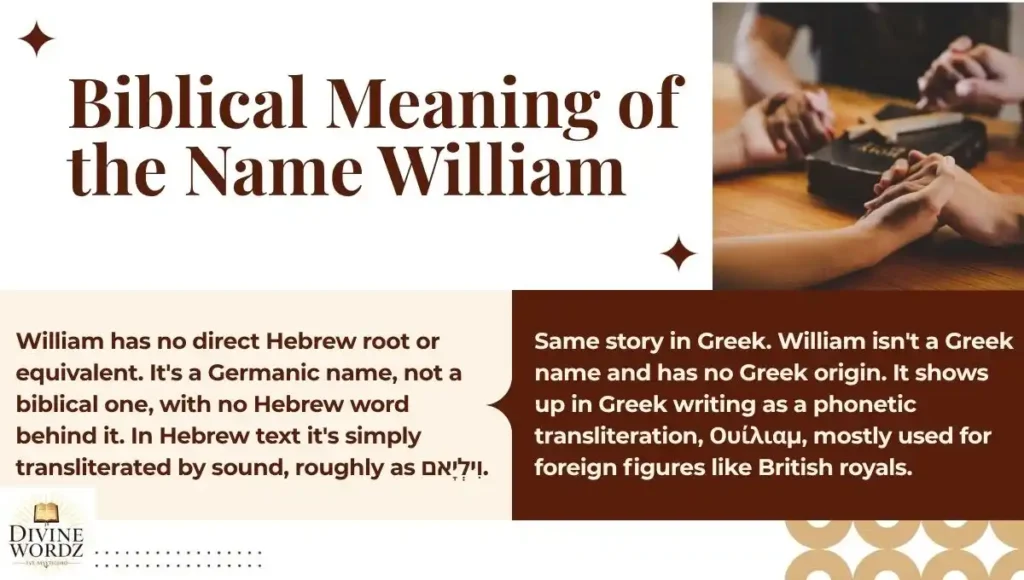
William has no direct Hebrew root or equivalent. It’s a Germanic name, not a biblical one, with no Hebrew word behind it. In Hebrew text it’s simply transliterated by sound, roughly as וִילְיָאם. A Hebrew name with a similar sense would be Shemaryahu, “God guards,” though it isn’t a translation of William.
The Meaning of William in Greek
Same story in Greek. William isn’t a Greek name and has no Greek origin. It shows up in Greek writing as a phonetic transliteration, Ουίλιαμ, mostly used for foreign figures like British royals. A Greek name sharing William’s protective spirit would be Alexandros, “defender of man.”
The Meaning of William in Urdu
In Urdu, William is written phonetically as ولیم and pronounced close to the English original. It has no roots in Urdu or Islamic naming tradition. It’s most commonly used among Christian communities across Pakistan and India, where it keeps its original Germanic meaning of resolute protector rather than gaining a new one in translation.
Embracing the Characteristics of William
For people who connect with this name, whether given it or simply drawn to the meaning of William, a few practical traits tend to come up again and again.
Cultivating Resolute Faith and Determination
Resolute faith isn’t about never having doubts. It’s about continuing to show up anyway.
- Build a consistent prayer or reflection habit, even a short one
- Return to your commitments after setbacks instead of abandoning them
- Ground decisions in values you’ve already thought through, not just the mood of the moment
Serving as Spiritual Protectors and Guardians
The “helm” side of the name points outward, toward the people around you.
- Speak up for someone who’s being talked over or overlooked
- Offer practical help before someone has to ask for it
- Keep confidences and act with steady reliability, not just good intentions
Nurturing a Trusting Heart
Determination on its own can turn rigid. What balances it is trust, the willingness to keep moving forward without controlling every outcome.
Surrendering Control to God’s Providence
For believers, this is often the hardest part of living out the name’s symbolism. Being a resolute protector doesn’t mean carrying every burden alone. It means doing the work that’s actually yours, then letting go of what isn’t.
Proverbs 3:5 puts it simply: trust in the Lord, and don’t lean entirely on your own understanding. That’s not a contradiction of strength. It’s what keeps strength from turning into exhaustion.
Embracing God’s Calling as William
History has its share of real people named William who lived out these themes in tangible ways. William Tyndale translated the Bible into English at real personal cost. William Wilberforce spent decades pushing to end the British slave trade.
Neither man’s legacy comes from the name itself, but their stories show what resolute faith and protective purpose can look like over a lifetime. That’s the invitation behind the meaning of William: not a guarantee of character, but a direction worth choosing.
FAQs
What does the name William actually mean?
William means “resolute protector” or “strong-willed guardian,” from the Germanic words wil (will, desire) and helm (helmet, protection).
Is William a name found in the Bible?
No. William is a Germanic name that didn’t exist when the Bible was written, so it doesn’t appear in the original Hebrew, Aramaic, or Greek text.
What is the spiritual or biblical meaning of William?
While not a scriptural name, its meaning of steadfast strength and protection closely mirrors biblical themes like courage, perseverance, and guarding others.
Does William have a Hebrew meaning?
Not directly. It has no Hebrew root, though names like Shemaryahu (“God guards”) carry a similar protective idea.
What does William mean in Greek?
William isn’t Greek either. It’s transliterated phonetically as Ουίλιαμ, with Alexandros being a Greek name that shares a similar “defender” meaning.
What does William mean in Urdu?
In Urdu it’s written as ولیم and used mainly by Christian communities in South Asia, keeping its original Germanic meaning rather than gaining a new one.
What are common variations of William around the world?
Wilhelm (German), Guillaume (French), Willem (Dutch), Liam (Irish), Guillermo (Spanish), and Guglielmo (Italian) are among the most widespread.
Is William a strong name to give a child?
Many parents choose it for exactly that reason. Its long history and meaning of resolute protection make it a name with genuine substance behind it.
Conclusion
The meaning of William comes down to two old Germanic ideas fused into one word: determined will and steady protection. It’s not a biblical name in the literal sense, and any honest article should say so plainly. But its themes, courage that doesn’t quit and strength used to shield others, echo through Scripture again and again, which is why so many believers feel a real connection to it.
Whether you’re choosing this name for a child, or you’re a William looking for a deeper sense of what you carry, the takeaway is simple. The name doesn’t guarantee character. It points toward one worth building, resolute, protective, and grounded in something bigger than yourself.

Welcome to Divinewordz! I’m Hasnain Raza. Christian Faith Writer | 6+ Years Bible Study Experience | Founder of (Divinewordz.com)
Sharing prayers, Bible Name Meaning and biblical wisdom to strengthen your faith.